
- Email yeldocollegesmd@gmail.com
- CALL +91 98461 10506 +91 98468 77776
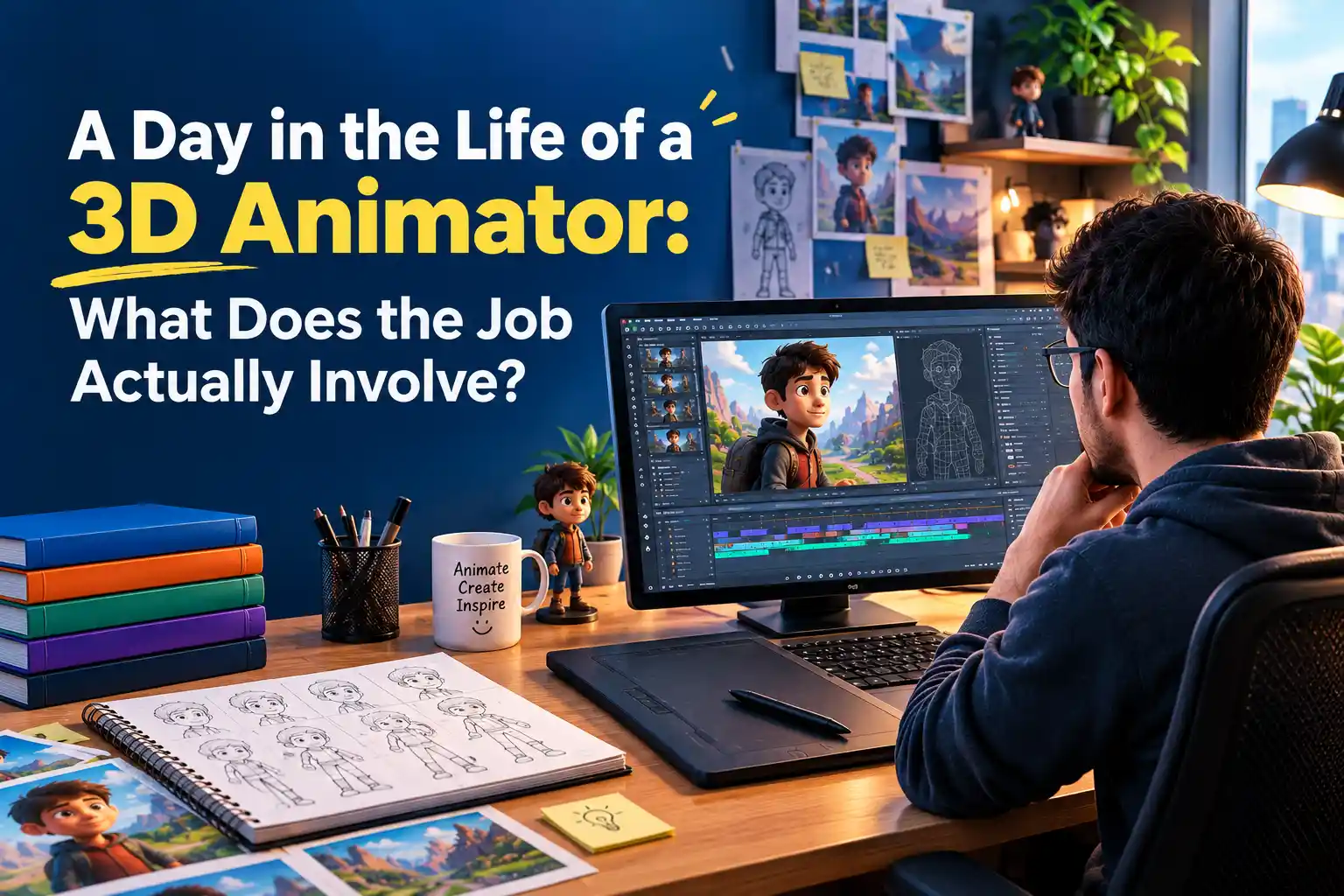
A 3D animator job involves much more than sitting at a computer and making characters move. Professional 3D animators work shot by shot within a larger production pipeline.Their work can include reviewing assigned shots, studying reference footage, creating movement, presenting work for feedback and revising animation several times. The exact routine varies by studio, project and role.
A 3D animator usually receives an assigned shot rather than starting with an empty scene. The production team may provide:
Before changing keyframes, the animator studies what the shot needs to communicate and how it connects with the wider sequence.
The core of 3D animator work happens inside animation software. The process develops gradually through several stages.
Blocking the Main Action
The animator establishes key poses, major movements and timing. Strong storytelling poses help the audience understand what the character is doing.
Refining the Motion
The animator improves spacing, arcs, weight, anticipation, follow-through and transitions to make the movement feel natural.
Polishing the Performance
The final stage may include facial expressions, eye direction, hand movements and subtle secondary actions.
The animator does not necessarily model or rig the character. In many studios, modelers and riggers prepare the character before animation begins.
A 3D animation shot rarely becomes final in one attempt. Animators typically follow a process such as animate → playblast → review → feedback → revise → review again. This allows the team to identify movement, timing or performance issues before final rendering.
A playblast is a quick preview of an animated shot. Instead of immediately creating a high-quality final render, animators use playblasts to check movement efficiently and make changes faster.
The review process may include:
The exact terminology, review schedule and approval process can vary between studios and projects. However, reviewing and revising animation is a regular part of professional 3D animation work.
|
Team Member |
How the Animator Interacts |
|
Animation Lead/Supervisor |
Reviews performance and provides notes |
|
Rigger |
Helps with character controls |
|
Modeler |
Provides 3D assets |
|
Lighting Artist |
Prepares shot lighting |
|
VFX Artist |
Handles effects and simulations |
|
Technical Artist |
Solves technical issues |
|
Director |
Provides creative direction |
|
Editor |
Connects shots within the sequence |
The exact team structure depends on the studio and production, so a 3D animator may work with some or all of these departments depending on the project.
Students exploring a BA Animation and Visual Effects College in Ernakulam can benefit from understanding this collaborative production environment.
A 3D animator job can look different depending on the industry, project and type of animation. A character animator working on a film may focus on acting, while a game animator may create movements that respond to player actions. Some animators also specialise in products, creatures, objects or environments.
In film and television, film animation often focuses on storytelling and character performance. Animators may work on:
The animator must make each movement support the story and feel natural within the scene.
A game animator creates movement that works within an interactive experience. Their 3D animation work may include:
Unlike film animation, game animation often needs to respond to player input and work smoothly within a real-time environment.
Advertising and product animation often prioritise clear presentation, precise timing and visual impact. Animators may create:
Therefore, the daily responsibilities of a 3D animator can vary significantly across film, television, games and advertising. Understanding these differences can help aspiring professionals identify the type of 3D animation career they want to pursue
A realistic 3D animator's work routine also includes:
No. A typical day can include:
This variety makes 3D animation work both creative and technically demanding.
|
Job Activity |
Useful Skill |
|
Blocking |
Posing and timing |
|
Character performance |
Acting and observation |
|
Refinement |
Spacing and arcs |
|
Feedback |
Communication |
|
Revisions |
Problem-solving |
|
Deadlines |
Time management |
|
Software workflow |
Technical proficiency |
|
Team projects |
Collaboration |
For students preparing for a 3D animation career, practical projects can provide valuable experience with professional workflows. Students exploring a 3D Animation College in Ernakulam can look for programs that combine animation fundamentals, software training and practical project work.
A junior animator may initially handle smaller or straightforward assignments, such as:
Responsibilities vary between studios, projects and individual skill levels.
3D animation jobs involve much more than simply making digital characters or objects move. The profession requires creativity, performance skills, software skills, feedback, revision, teamwork, and the ability to meet project deadlines. Most animators tackle each shot one at a time, improving the motion until it sufficiently captures the desired action along with the corresponding emotion.
Interested in building a career in 3D animation? Explore practical training at YMBC and develop animation, storytelling and production skills through hands-on projects.
A 3D animator reviews assigned shots, studies references, creates and refines movement, attends reviews and responds to feedback.
Responsibilities include animating assigned shots, refining movement, meeting deadlines, managing files and collaborating with production teams.
Not usually in larger studios. Modellers and riggers often handle these tasks, allowing animators to focus on movement and performance.
Revision can take a significant part of the workflow. Animators may adjust a shot several times based on feedback before final approval.
Tags: 3D Animation, 3D Animator, 3D Animator Job, 3D Animation Jobs, 3D Animation Career, 3D Animator Workday, 3D Animation Work, Character Animation,

October 28, 2026

October 28, 2026
October 28, 2026
October 27, 2026

October 27, 2026

October 27, 2026
October 27, 2026

October 26, 2026
September 22, 2026
September 22, 2026
September 22, 2026
September 22, 2026
September 21, 2026
September 21, 2026

September 21, 2026

September 21, 2026
September 07, 2026
September 07, 2026
August 29, 2026
August 29, 2026
August 28, 2026
August 28, 2026

August 28, 2026
August 28, 2026
July 27, 2026
July 27, 2026
July 27, 2026
July 27, 2026

July 25, 2026

July 25, 2026