
- Email yeldocollegesmd@gmail.com
- CALL +91 98461 10506 +91 98468 77776
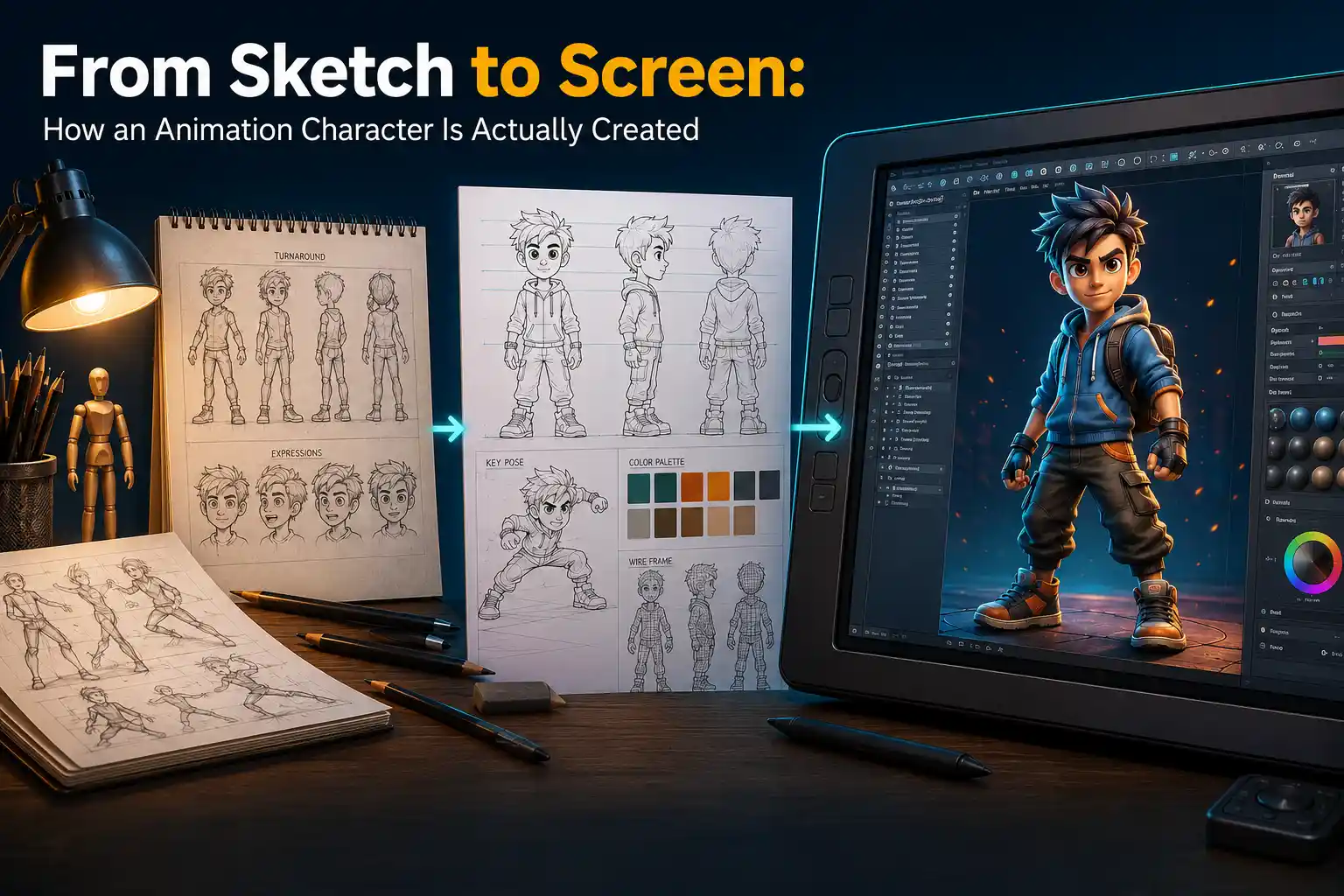
An animation character may look simple on screen a person walking, a talking cartoon animal, or a superhero jumping, but creating that character involves a complex combination of creativity, design and technical skills. Character design, modelling, rigging and animation are among the interconnected stages involved in bringing a character to life. From the initial idea to the final rendered scene, artists and animators have to go through a number of interrelated stages of work.
Character development starts with the story and personality, not the software. Before the artists begin modelling or animating, they must know:
Effective character design can communicate aspects of a character’s personality, role and background without relying on dialogue.
Silhouette is one way that people can easily recognize a character. A distinct look should be achieved from the body form, hair, costume, and accessories. This is the reason why silhouette, personality, and visual development of a character are important elements of character design in animation.
It takes more than just one sketch to make the character ready for production. Artists have many references to ensure consistency in their characters. This can range from character sketches, character designs, expression sheets, posing drawings, model sheets, and character turnarounds.
A character turnaround typically shows the character from multiple angles, such as the front, side, back and three-quarter views. These references assist the artists in keeping the proportion and appearance of the character consistent even if the character changes poses and scenes.
The way an animation character is created depends greatly on the chosen animation medium. While both 2D and 3D animation aim to bring characters to life, the preparation, tools, and production stages can be quite different.
In 2D character animation, artists primarily work with drawings or digital 2D assets. A character may go through stages such as:
Frame by frame animation creates movement by drawing individual poses or frames, while cut out animation uses separate character parts that can be digitally controlled and moved.
A 3D character is created as a digital three dimensional model. Its workflow may include:
Unlike 2D characters, 3D characters need a complete digital form that can be viewed from different angles. They also require a rig so animators can control the character's movement.
There is no single character animation workflow. The pipeline varies based on the style, studio, medium, software, budget, and platform. A simple advertisement may need fewer stages than a feature film or game. Students should focus on understanding the core principles of the pipeline rather than following one fixed process.
3D character design creates the character’s complete form, including the body, face, clothing, hair, and accessories. Topology arranges polygons and edges to ensure smooth, natural deformation during movement. Good topology is especially important around joints and facial areas.
Texturing and shading define the character’s colours, skin, hair, clothing, and materials. Textures control surface details, while shading determines how the character reacts to light. Together, they establish the character’s visual style and personality.
Character rigging can be compared to building a digital skeleton inside the character. It provides bones, joints, controls, and systems that allow animators to move the character.
The process can include:
Rigging is the link between the character’s model and the process of animating it. It is impossible to make a good animation without a good rig.
Skinning controls how the character mesh moves with the bones, while weight painting determines each bone’s influence. Proper skinning ensures natural movements, such as smooth elbow and shoulder bends and realistic finger motion, preventing unwanted deformations.
Animation brings the prepared character to life by controlling actions, timing, movement, gaze, and emotions. Key principles include:
For example, lifting a heavy box can show weight and effort through careful poses and timing. Character animation is not just moving a rig it is creating a performance.
The face is a key tool for emotional communication, using the eyes, eyebrows, mouth, jaw, expressions, and lip sync. Facial rigs, blend shapes, poses, and keyframes help characters express emotions such as happiness, fear, anger, and sadness.
Before production, characters are tested for movement and performance, including walking, running, posing, and facial animation. These tests help identify issues in the model, rig, skinning, or animation before they become difficult to fix.
The animation pipeline continues with camera work, lighting, rendering, visual effects, compositing, and colour correction. Lighting shapes the character’s appearance and emotions, while rendering creates the visual frames and compositing combines elements into the final image.
Character consistency is essential in films, series, games, and advertising. Characters must maintain consistent proportions, costumes, colours, facial features, and visual style. Animation can also be transferred between compatible characters, helping teams reuse motion and maintain efficient production workflows.
Students are not expected to master every stage of production immediately. Instead, they can gradually develop skills across four main areas:
Understanding the whole process also helps students make informed decisions about their areas of specialisation.
AI can support character develoment, concept exploration, reference generation, and style experimentation, making early development faster. However, human judgement is still essential to assess anatomy, consistency, originality, story relevance, and production suitability. AI can speed up exploration, but effective character development still requires creative and technical skills.
A simplified animation production pipeline can be understood as:
Real productions may repeat, overlap, or rearrange these stages depending on their requirements.
Students benefit from understanding what happens before and after their own role. A character animator should know how modelling and rigging affect movement, while a character designer should understand how their design will eventually be modelled, rigged, animated, and rendered.
This broader knowledge is particularly useful for students exploring BA Animation and Visual Effects courses, because professional animation depends on collaboration between different creative and technical roles.
2D animation teaches fundamental principles such as pose, timing, expression, movement, exaggeration, character acting, and visual storytelling. These skills remain valuable even when students later move into 3D animation, VFX, games, or digital character workflows.
For students considering a 2D Animation College in Ernakulam, learning these fundamentals can provide a strong foundation for understanding movement and performance before progressing into more advanced production techniques.
An animation character goes through several stages, from story and character design to modelling or 2D preparation, texturing, rigging, animation, lighting, rendering, and compositing. Each stage helps turn a creative idea into a character that can communicate, move, and perform effectively.
For students, understanding the complete character animation process is more valuable than learning just one application. A strong foundation in 2D and 3D animation helps them create production ready characters for real-world projects..
Exploring BA Animation and Visual Effects courses at Yeldo Mar Baselios College can be a valuable step for those interested in developing practical skills in character design, animation, modelling, rigging, and visual storytelling.
An animation character usually begins with story development, personality, and visual design. Artists then create sketches and production references before preparing a 2D asset or 3D model. The character may then go through texturing, rigging, animation, lighting, rendering, and compositing before appearing in the final scene.
Understanding the story of the character, its role, personality, and appearance is normally the first thing artists should do before creating sketches and designs of a particular character. This will be a basis for modelling and rigging of the character that is consistent with its purpose.
Rigging involves developing the framework and controls needed to pose a character. It includes components such as bone, joint, and control setups; skin weighting; weight painting; and facial controls. Good rigging makes animation easier, and it enables the character to move more naturally.
Topology refers to the arrangement of polygons and edges within the 3D model. Topology plays an essential role in the deformation of the model during various movements of the character such as bending, walking, running, speaking and changing of expressions among others.
2D character animation mainly makes use of drawings or 2D assets to produce movements, whereas 3D character animation utilizes 3D models. A 3D character can undergo rigging, posing, animation, lighting, and rendering in a 3D world. Both forms of animation make use of basic concepts such as timing, posing, expression, and storytelling.
Tags: Animation Character, Animation Character Design, Character Animation, 2D Character Animation, 3D Character Animation, Character Design in Animation, Character Rigging, 3D Character Design, Animation Pipeline
September 07, 2026
September 07, 2026
August 29, 2026
August 29, 2026
August 28, 2026
August 28, 2026
August 28, 2026
August 28, 2026
July 27, 2026
July 27, 2026
July 27, 2026
July 27, 2026

July 25, 2026
July 25, 2026
July 25, 2026
July 25, 2026
June 27, 2026
June 27, 2026
June 27, 2026

June 27, 2026
June 27, 2026
June 26, 2026
June 26, 2026
June 24, 2026

May 29, 2026
May 29, 2026
May 28, 2026

May 28, 2026
May 28, 2026
May 28, 2026