
- Email yeldocollegesmd@gmail.com
- CALL +91 98461 10506 +91 98468 77776
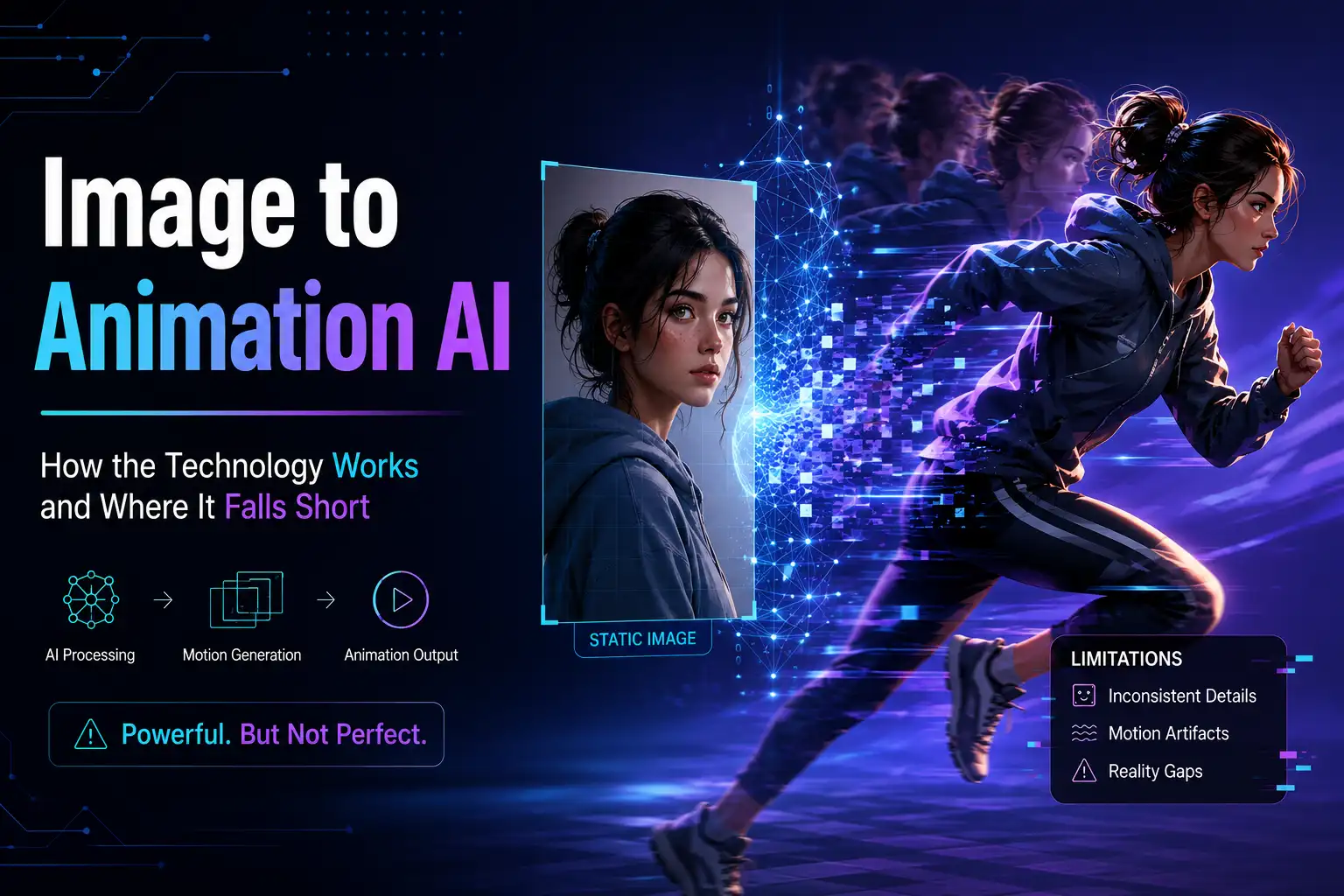
Image to animation AI is quietly changing the way creators work with visuals. Feed it a single photograph, illustration, or piece of digital art, add a short prompt, and within a few clicks that still image starts to move. With AI animation and AI image animation, work that used to demand careful keyframing and hours of manual editing can now begin with nothing more than one static picture.
At first glance, the result can look a lot like traditional animation. But the process behind it is nothing alike. Rather than an animator carefully building every pose and transition by hand, generative AI looks at the visual information already present in the image and tries to predict how that scene might unfold over time.
That's what makes the technology so appealing for quick experimentation, concept development, social media content, and previsualisation. But it also comes with real limits around motion control, keeping characters consistent, physics, and longer sequences.For anyone considering animation as a career, understanding both sides of that trade-off matters.
It starts with a source image. The AI system reads the elements in it , the subject, composition, lighting, background, colours, and overall visual style. From there, a text prompt describes the kind of movement you want, something like “hair blowing gently in the wind” or “camera slowly pushing toward the character".
The process is not simply a matter of shifting the original pixels around. Most modern image to video systems rely on diffusion based approaches, using the input image to guide the generation. Research on image to video generation generally frames it as a balancing act: the model has to hold onto the identity and content of the reference image while still producing motion that looks coherent from one frame to the next.
The model then builds out a sequence of frames that reads as movement. Essentially, it's guessing at what plausible next frames could look like, based on patterns it has picked up from enormous amounts of visual and video data.
A still image, by definition, holds no information about what happens a second later. So, the AI has to estimate it.
Say the image shows someone standing outside. The system might add blinking, some hair movement, a shift in facial expression, or a slight camera drift. Run the same prompt twice, and you'll likely get two different results, because the model isn't retrieving a fixed animation; it's making a probabilistic guess each time.
The quality of the starting image has an outsized effect on the outcome. A clear subject, decent resolution, lighting that makes sense, and well defined facial or character details all give the system more to work with.
On the flip side, a cluttered background, blurry subject edges, or distorted features tend to make AI video generation shakier. Simply put, the better the visual reference, the more information the model has to work with when it attempts motion generation.
One of the trickiest parts of image to animation AI is figuring out what should change and what should stay put.
The system needs to tell apart the following:
Take a portrait as an example. An AI animation system might add blinking, hair movement, or a gentle camera push. Feed it a product shot, and it may generate camera movement or animate one particular part of the product. Give it an illustrated character, and it could add facial expressions or body movement.
But here's the catch: the model is producing plausible motion, not necessarily understanding the scene the way a human animator would. That's why a first result can look genuinely impressive and still contain changes nobody asked for.
Modern image to video AI can turn out short clips that are genuinely convincing. But the more complicated the scene, the higher the odds of something going visibly wrong. Research on video generation keeps circling back to the same challenges: temporal consistency, dynamic scenes, coherence over longer durations, and physical plausibility.
Fast movement, several characters in frame, busy backgrounds, objects interacting with each other, walking, running, and detailed hand movement – all of it asks the system to hold onto more information across more frames, and that's exactly where things start to slip.
Small mistakes tend to stand out most in:
A slightly off background rarely gets noticed. An extra finger or a face that subtly reshapes itself, though, is enough to make the whole animation feel artificial.
Temporal consistency is just a technical way of saying visual elements should stay logically connected from one frame to the next. Picture a character whose face looks one way in frame one, and by frame twenty the eyes, hairstyle, or facial proportions have quietly drifted. The motion itself might be smooth, but the character doesn't read as the same person anymore. This is still very much an active research area, especially for longer and more complex video generation.
The technology is genuinely impressive, but it's worth understanding where its limits sit before treating it as a complete animation solution.
AI can follow general instructions like “walk forward slowly” reasonably well, but nailing precise timing is a different story. Traditional animation gives artists control over individual poses, spacing, timing, and anticipation of every beat of the movement deliberately.
Characters can shift in appearance from one frame to the next. Clothing, accessories, facial details, and objects may warp or move in ways they shouldn't. That makes consistency a real concern in any professional production pipeline.
The longer the sequence, the harder consistency becomes to hold onto. Research into long form video generation is still working through problems like temporal degradation and the model losing track of information it generated earlier. For most practical projects, it's often more realistic to generate a handful of short clips and stitch them together in editing, rather than betting everything on one long, uninterrupted generation.
AI generated animation can look visually striking while completely ignoring real world physics. Feet that float instead of planting, objects that seem to weigh nothing, liquid that moves strangely, cloth that behaves unnaturally, or objects that pass straight through each other, these show up more often than you'd expect.
If a photo only shows the front of an object, generating a full camera rotation means the AI has to guess what's on the back. And that guess can easily be wrong.
The more useful question isn't whether AI animation beats traditional animation. It comes down to control and workflow; The two approaches are built around different trade-offs.
|
AI Animation |
Traditional Animation |
|
Generates motion from learned visual patterns |
Artists deliberately design movement |
|
Enables fast experimentation |
Offers detailed manual control |
|
Useful for concepts and short clips |
Suitable for controlled production pipelines |
|
Can introduce unexpected changes |
The artist controls poses and timing |
|
Requires review and correction |
Requires greater production time and skill |
An animator still decides what moves, why it moves, how it should move, and how that movement serves the story or the emotion behind it. That's exactly why animation education hasn't lost its relevance. AI can produce an output, but recognising whether that output actually works still comes down to visual judgement.
Students are better served learning AI tools alongside animation fundamentals, not instead of them. Skills worth holding onto include:
AI tools tend to work better in the hands of someone who already understands animation. A beginner might just accept the first thing the model generates, while a trained animator can spot exactly why a movement feels off and knows what needs fixing.
For students exploring BA Animation and Visual Effects courses in Kerala, building a foundation in both creative fundamentals and emerging technologies tends to pay off across modern production workflows.
The real question here is "Why study animation if AI can animate images?” Future creators will likely need a mix of things: animation fundamentals, AI literacy, visual storytelling, editing, VFX, 3D workflows, creative direction, critical evaluation, and a solid portfolio.
Animation with AI can genuinely help with:
That said, AI generated animation still needs a human eye for quality control. Students who already understand movement can write better prompts, catch errors faster, and make more informed calls about what makes the final cut.
For learners interested in a 3D animation course in Kerala, AI is best thought of as a complement to modelling, texturing, rigging, animation, lighting, rendering, and post production, not a replacement for any of it.
The technology is already being used in several practical applications. Google Photos, for example, has introduced photo-to-video features that can turn still images into short video clips. At the same time, Google's Gemini added its own photo to video generation for creating dynamic clips.
Useful applications include:
The strongest use cases tend to be the ones where speed and experimentation matter more than frame by frame precision.
AI can speed up several stages of production, but human creators are still the ones providing direction, storytelling, aesthetic judgement, and quality control.
The workflow in the future will probably blend generative AI with conventional animation, editing, VFX, 3D software, and compositing. For students, that means learning how the technology works while also building the creative judgement needed to evaluate what it produces.
For anyone considering a BA Animation and Visual Effects College in Ernakulam, the skill set worth building is broader than knowing one particular AI tool. It comes down to understanding animation principles and figuring out how emerging technology fits into a professional creative workflow.
Image to animation AI has made turning a still image into moving content faster and more accessible than ever. Its strengths are speed, experimentation, accessibility, and quick visual development. But limitations around temporal consistency, complex motion, character identity, physics, precise control, and longer sequences are still very real.
None of that makes traditional animation irrelevant; if anything, it makes animation knowledge more valuable, not less. Creators who understand storytelling, movement, timing, composition, and visual communication are in a far better position to direct and judge AI generated results.
The future of animation is unlikely to depend on AI alone. Image-to-animation tools and other generative AI technologies can speed up parts of the production process, but it's still human creativity that decides whether the final result actually communicates something. For students, pairing animation fundamentals with AI video generation is likely to build a stronger, more adaptable creative skill set.
Yeldo Mar Baselios College offers a range of courses in animation and visual effects. If you are interested, explore the available course options and find one that suits your creative interests.
Image to animation AI refers to technology that takes an existing image as a visual reference and generates movement from it. The system reads the image and builds additional frames based on a prompt or a predefined type of motion, and it can work on photographs, illustrations, characters, and other static visuals.
Image to video systems use a source image to guide the generation process and predict how the scene might develop over time. Diffusion-based models are widely used for image-to-video generation, although different systems use different architectures and generation methods.
Many types of images can be used as input, but not every image will produce reliable or useful animation results. High quality images with a clear subject and a simple composition tend to give the best results. Complex backgrounds, unclear details, unusual poses, or low-resolution images are more likely to produce unstable animation.
The main ones are motion consistency, character consistency, complex movement, short generation durations, physics errors, and limited control over exact timing. AI generated animation can also introduce changes you didn't ask for in faces, hands, clothing, objects, or backgrounds.
AI is reshaping animation workflows, but it hasn't removed the need for creative direction, storytelling instinct, animation knowledge, quality control, or production expertise. AI animation can speed certain tasks up, but skilled animators are still the ones deciding what the movement should communicate and whether the result actually works.
Tags: Image to animation AI, AI animation, AI image animation, Image to video AI, AI video generation, Generative AI, Animation, Animation fundamentals, AI animation tools
September 22, 2026
September 22, 2026
September 22, 2026
September 22, 2026
September 21, 2026
September 21, 2026
September 21, 2026
September 21, 2026
September 07, 2026
September 07, 2026
August 29, 2026
August 29, 2026
August 28, 2026
August 28, 2026
August 28, 2026
August 28, 2026
July 27, 2026
July 27, 2026
July 27, 2026
July 27, 2026
July 25, 2026
July 25, 2026
July 25, 2026
July 25, 2026
June 27, 2026
June 27, 2026
June 27, 2026
June 27, 2026
June 27, 2026
June 26, 2026